Skin Master Clinic
From three people juggling spreadsheets to one receptionist running the clinic online.
- Role
- Product Owner, Business Analyst and engineer
- Timeline
- Jul – Nov 2026
- Context
- Independent · client project
- Status
- Live
Problem
Bookings came by phone and WhatsApp and were tracked by hand. Patient history, bills and product stock lived in separate Google Sheets kept by three people, and the doctor had to supervise every entry.
Outcome
One secure system now holds bookings, patients, visits, bills, stock and reviews. A single receptionist runs the front desk from a phone or tablet, and the clinic owner oversees everything from the admin.
- 3 → 1people needed for front-desk admin
- 500+patients in one system
- 10–15online bookings a month
- 9releases in four months
- Discover
- Understand
- Define
- Ideate
- Prototype
- Build
- Launch
- Adopt
- Measure
- Improve
Discover · Understand · Define · Ideate · Build · Launch · Adopt · Measure · Improve
Before and after
How it works now
- 01
Patient books online
At any hour, after agreeing to the terms. Staff get a push notification.
- 02
Front desk confirms
One tap adds it to Google Calendar, with a clash check.
- 03
WhatsApp reminder
Sent with one tap the day before.
- 04
At the visit
The patient's full history is on one page.
- 05
After the visit
One form saves remarks and products; the bill and stock update themselves.
- 06
Follow-up
"Book next" and a review request on WhatsApp.
- 07
Month end
Bookings to CSV, stock to Excel, and analytics on where patients came from.
The problem
Skin Master Clinic is a skin, hair and aesthetics clinic in Pune. Before this project it ran entirely by hand. Appointments came by phone and WhatsApp with no single list of who was coming when. A returning patient’s treatments and payments had no fixed home. Stock was a spreadsheet that had to be subtracted by hand, and bills were worked out per visit. Three people kept it all going, and the doctor had to check their work.
The clinic needed one place for everything, simple enough for one person at the front desk.
My role
Product owner, business analyst and engineer. I ran demo-and-review cycles with the clinic owner, turned what I heard into a prioritised backlog, and made every scope call with the owner’s sign-off. The first version went live in under seven weeks; eight more releases followed, each reviewed with the clinic.
Two halves, one database
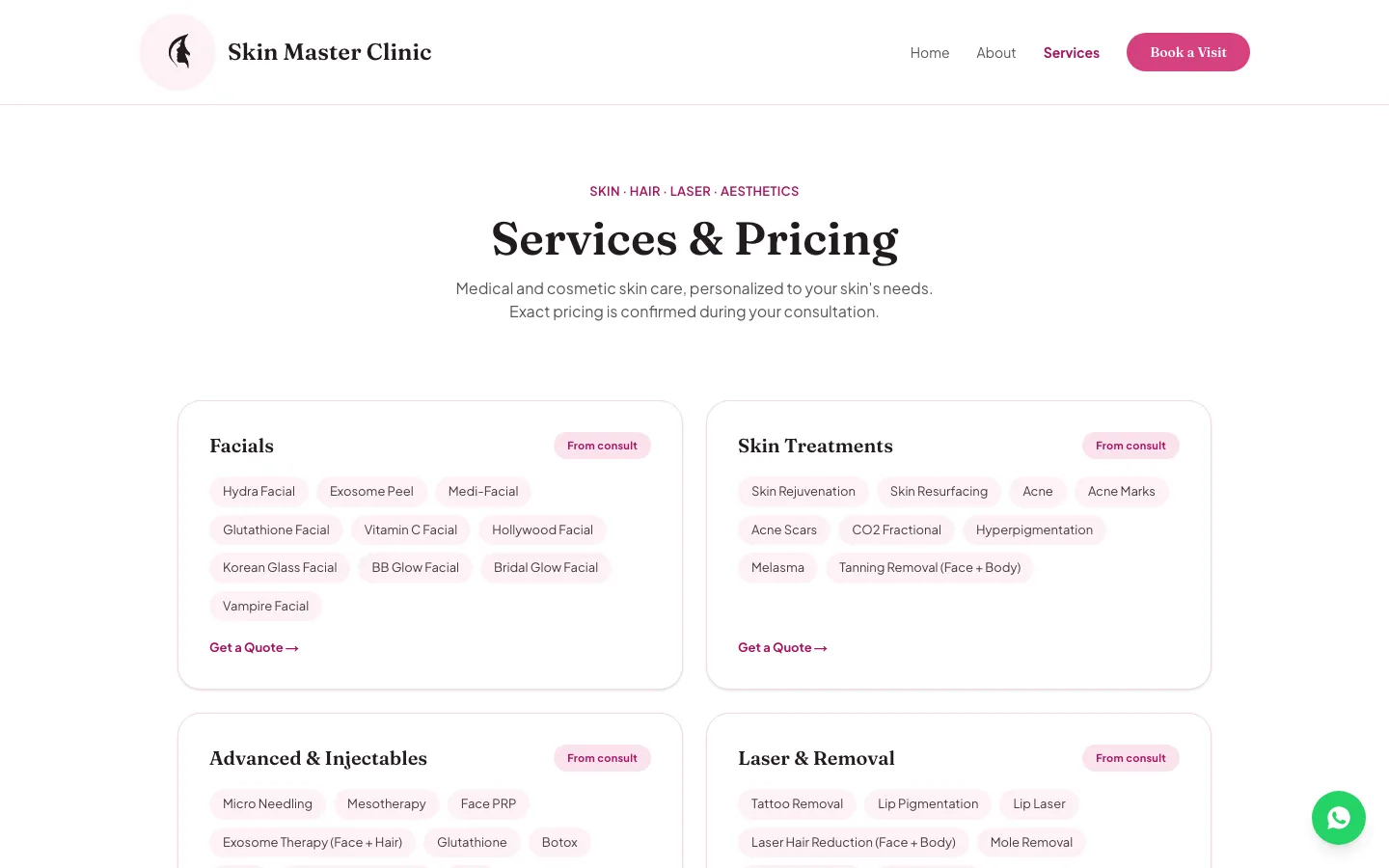
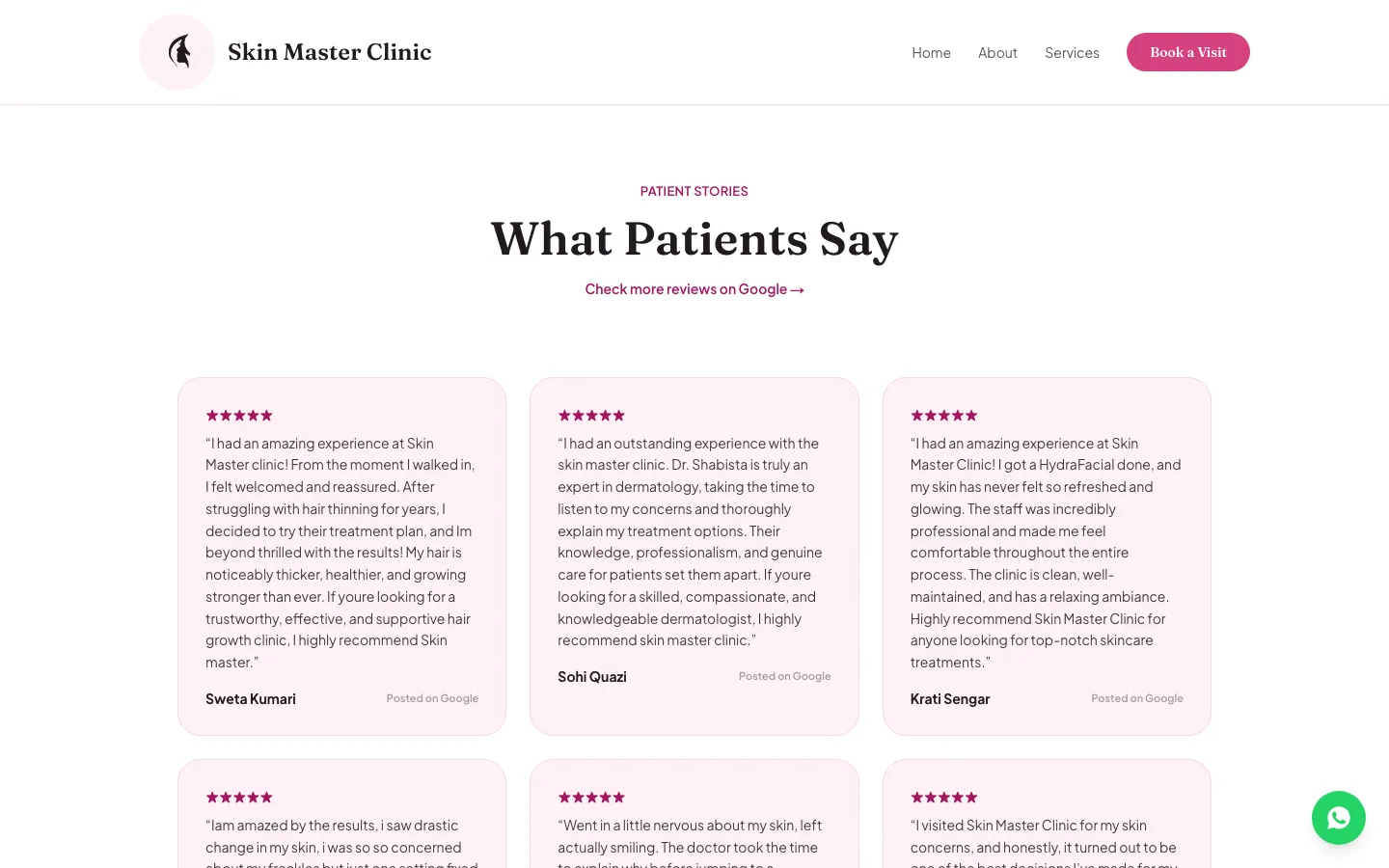
- A patient-facing website, mobile-first because most patients arrive from a phone: services, the doctor’s profile, opening hours, a map, testimonials with Google reviews, and a booking form with required consent.
- A private clinic system built for a phone, the clinic’s tablet and a small laptop: dashboard and calendar, appointments, patient history, visit billing, product stock, WhatsApp messages, review moderation and analytics.
Key decisions
| Decision | Why |
|---|---|
| Patients identified by mobile number | Every past booking joins up automatically, without asking patients to create accounts |
| Bills recalculated on the server | A figure can’t be changed from the browser |
| Row-Level Security limited to three named admins | Being signed in isn’t enough to read patient data, and public sign-up is off |
| WhatsApp links, not an SMS service | Patients are already there, and it costs nothing |
Privacy built in
Because the system holds health information, I treated Indian privacy law as a feature: a lawyer-drafted privacy policy (DPDP Act 2023 and Rules 2025, IT Act and SPDI Rules), consent recorded with a timestamp on every booking, cookie switches before any analytics, and automatic deletion of stale requests after 12 months. Each promise in the policy is backed by a feature.
When things broke
After launch, Google rejected every calendar event with “time range is empty”. I tested against the live API with standalone scripts and traced it to a timezone conversion that silently turned local times into UTC, plus a corrupted service-account key in the hosting settings. I fixed both, verified against production and confirmed with the owner. The lesson I now write into every test plan: static checks don’t prove an integration works; test against the real service.
What’s next
A custom domain, an access audit log ahead of the DPDP logging requirement in May 2027, and scheduled WhatsApp reminders.
Screens


Stack and tools